
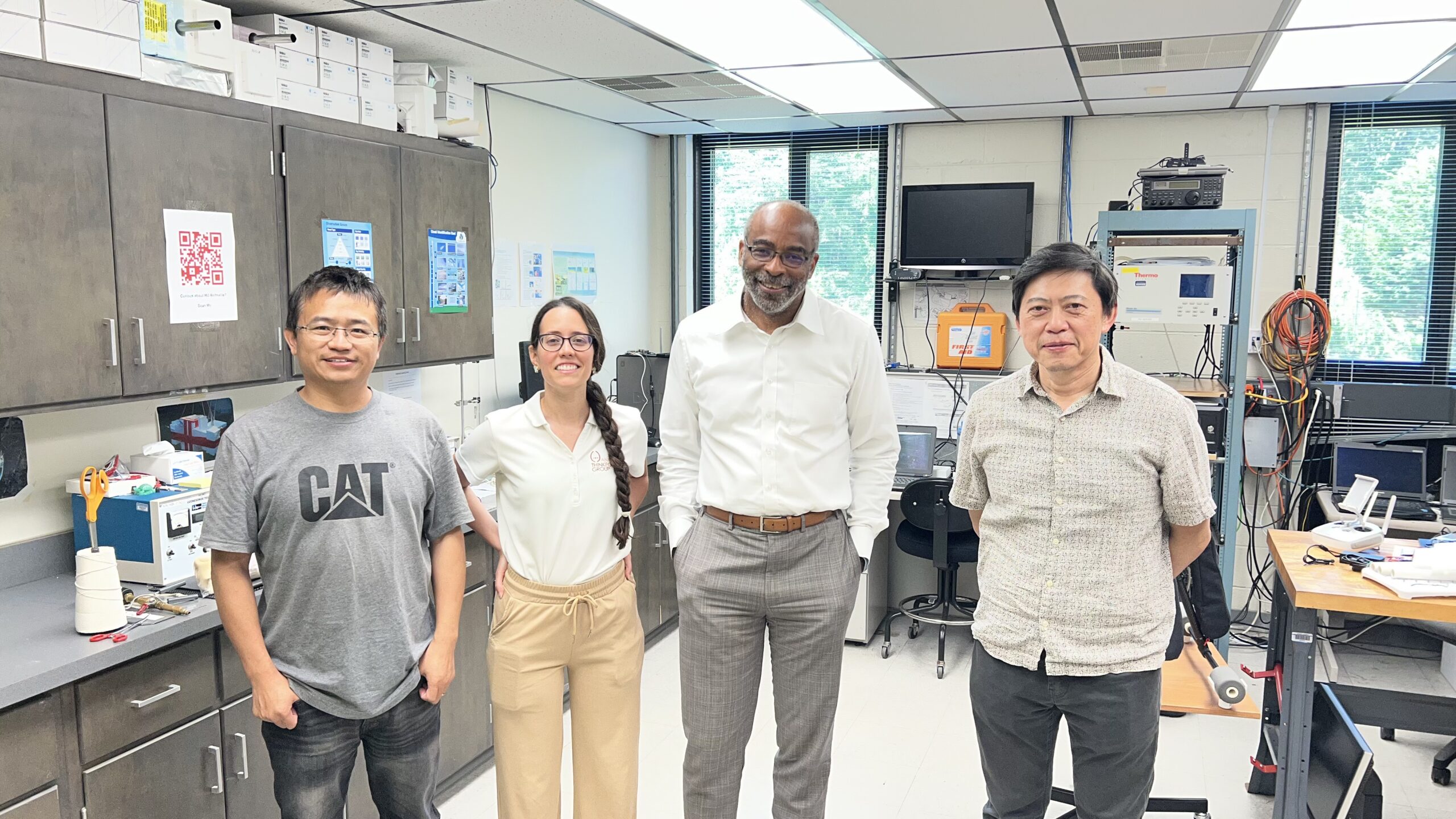
A few weeks ago, the Howard University Beltsville Campus (HUBC) had the honor of welcoming back Dr. Everette Joseph, one of the people whose vision helped shape the Beltsville atmospheric research station into what it is today.
Dr. Joseph visited and toured the current radiosonde laboratory, where generations of atmospheric researchers and students have collected and analyzed data that contribute to our monitoring and understanding of the atmosphere.

As Dr. Joseph walked through the facility, he began recognizing something unexpected: his own handwriting and labels were still there. Notes that he had written and markings that he had made years ago remained intact, connecting the laboratory of today with the people and ideas that helped build it.
Dr. Joseph’s contribution to Beltsville was substantial. He was one of the pioneers of the program, NOAA Center for Atmospheric Sciences and Meteorology, NCAS-M, which helped to acquire founding during the first years of HUBCs’ development. During his time at Howard University, he directed the Howard University Program in Atmospheric Sciences (HUPAS) and also led the research conducted at the Beltsville site. Years later, his leadership was instrumental in the creation of the Beltsville Center for Climate System Observation (BCCSO), a NASA University Research Center that brought together Howard University, NASA, NOAA, and other research partners around atmospheric observations.
Among those of other scientists, his efforts developed Beltsville into an important environment for atmospheric research, student training, satellite validation, and field observations.
Since 2019, Dr. Joseph has served as Director of the National Center for Atmospheric Research (NCAR) in Boulder, Colorado, continuing his career dedicated to atmospheric science and the mentorship of future generations of researchers.
Having him back at Beltsville was therefore particularly meaningful. When a scientist comes back years later and recognizes traces of his own work present in a lab, we are reminded that the science we do today is built on the people who came before us.