
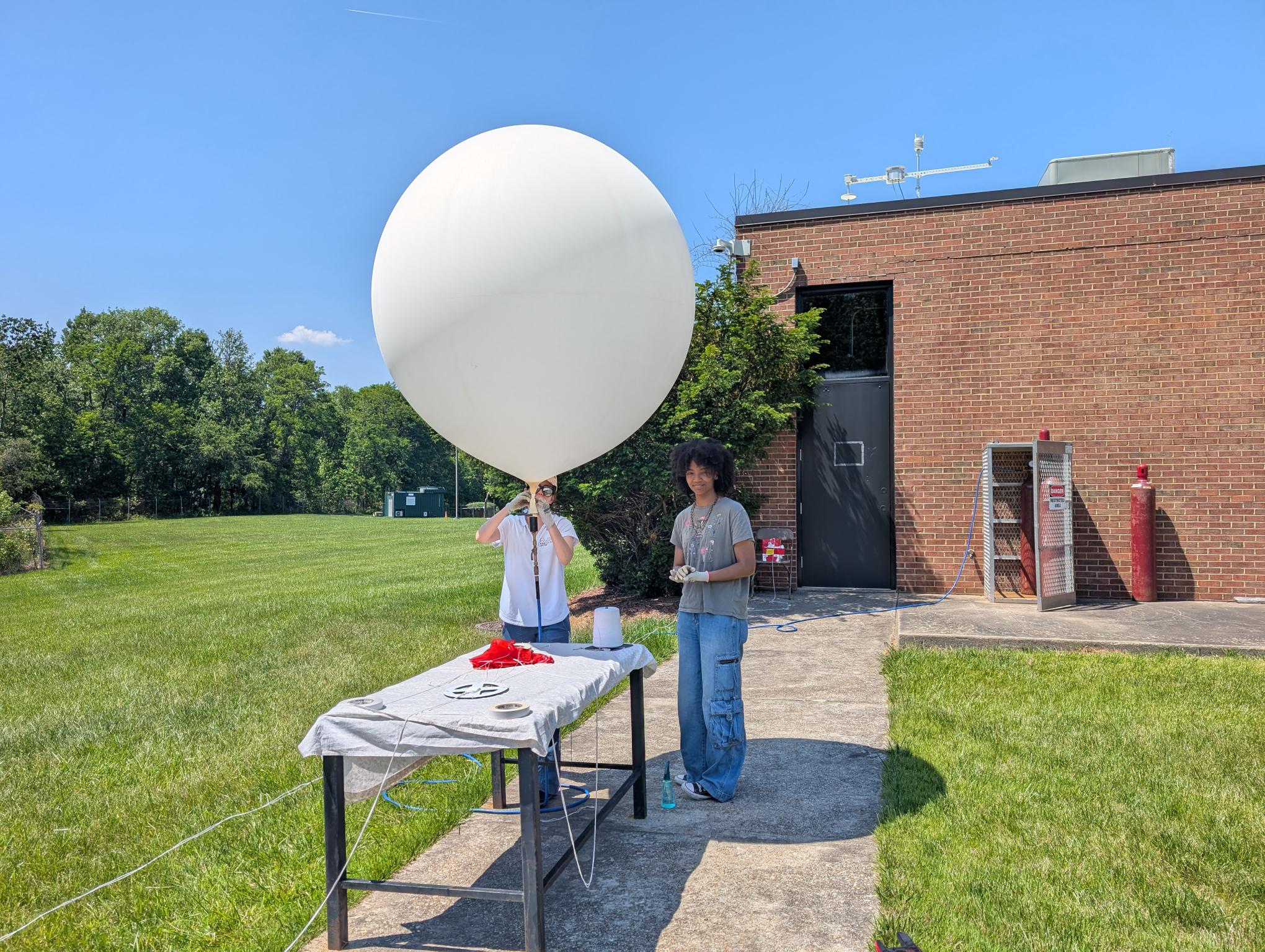
The week of July 13–17 experienced a significant heat wave across the northeastern United States, leading to enhanced surface ozone formation throughout the Upper East Coast. During this period, Howard University Beltsville Campus (HUBC) scientists, Dr. Ricardo Sakai and Rocio Rossi, conducted eight ozone-monitoring weather balloon launches, twice daily at 2:00 AM and 2:00 PM, in collaboration with the Maryland Department of the Environment (MDE). These launches provided high-resolution vertical profiles of atmospheric ozone, allowing the monitoring of concentrations from the surface through the troposphere and into the stratosphere.
The primary focus of the campaign was to characterize ground-level ozone, a harmful air pollutant produced when nitrogen oxides (NOₓ), largely released from motor vehicles, power plants, and other combustion sources, react with volatile organic compounds (VOCs) in the presence of strong sunlight. High temperatures, intense sunlight, and stagnant winds accelerate these reactions while limiting the dispersion of pollutants, often leading to unhealthy ozone concentrations. These meteorological conditions were all present during the July heat wave, making it an ideal period to investigate ozone production and its vertical distribution. The balloon observations provide valuable information in order to better understand ozone transport and improve atmospheric chemistry models used to protect public health.

Howard University students always play an active role in these kinds of campaigns.
Pictured above is Chancelor Anderson, a rising Environmental Science major at Howard University. Throughout the campaign, she participated in every stage of the balloon launch process, from instrument calibration and payload assembly to pre-launch procedures and balloon release, gaining experience in atmospheric field observations.

As part of the Howard University student training effort, Tadashi Sakai, a rising physics student, also took part in the campaign. His participation reflects the program’s commitment to providing undergraduate students with meaningful research experiences in atmospheric science.


This ozone producing heat wave took effect at the same time that Canadian wildfire smoke intrusion was transporting exceptionally high concentrations of PM₂.₅ into the Mid-Atlantic and Northeast. NASA documented that smoke from Ontario wildfires reached the Baltimore–Washington region during July 14–20, 2026, producing extremely high PM₂.₅ concentrations and triggering Code Purple air quality alerts.
Above is an ozone sonde profile of July 17th in the afternoon. The profile shows the good and the ugly. High ozone concentrations centered between approximately 20 and 30 km altitude, where ozone partial pressure reaches a maximum of about 13.2 mPa, consistent with a healthy stratospheric ozone layer that efficiently absorbs harmful ultraviolet radiation. However, one can also observe that ground ozone’s partial pressures on the order or 9 mPa are consistent with elevated ground-level ozone. This corresponds to approximately 85-90 ppbv, indicating dangerous surface ozone capable of contributing to respiratory irritation, especially when combined with the exceptionally high PM₂.₅ from the Canadian wildfire smoke.