This July, HUBC’s team of scientists had the honor of welcoming the first cohort of National Science Foundation (NSF) Research Experiences for Undergraduates (REU) students at the University of Maryland, Baltimore County (UMBC). Led by Dr. Adriana Rocha Lima, Assistant Professor in the Department of Physics at UMBC, the students spent ten weeks immersed in the world of Earth and Atmospheric Science, exploring the processes that shape our atmosphere and the different ways in which scientist study them.
For the students visiting HUBC, that experience meant stepping into a living atmospheric laboratory.

One of the highlights of the visit was a detailed demonstration by Dr. Demoz of the Raman lidar system at HUBC.
He explained in detail the particulars of how the instrument works: a laser sends an extremely short pulse vertically into the atmosphere and as that pulse travels upward, it encounters molecules, aerosols (mainly dust, smoke, pollution, sea salt, and other tiny airborne materials), as well as water vapor. The very small fraction of the laser light scattered back toward the instrument tells a whole lot about the composition of the atmosphere at that location. Raman spectroscopy in a nutshell! Dr. Demoz also delved deep into the applications of this instrument and the important role it plays in air quality monitoring and satellite observations.

The cohort was lucky to visit on the same day that scientists from the Maryland Department of the Environment (MDE) were conducting measurements on the air-quality monitoring supersite inside our campus.
The students had the opportunity to see how atmospheric pollution is monitored in the real time and how multiple instruments can work together to characterize the chemical environment of the atmosphere, specifically gases such as carbon monoxide (CO), carbon dioxide (CO₂), and ozone (O₃), along with measurements associated with particulate pollution, including black carbon and brown carbon.

Students visiting our rooftop were introduced to several atmospheric monitoring instruments, such as our microwave radiometer (MWR), our Multi-Filter Rotating Shadowband Radiometer (MFRSR), our Pandora spectrometer, and our GNSS/GPS antenna, among others. Perhaps the most important lesson from the visit was that there is no single instrument capable of telling us everything about the atmosphere, rather students were able to see this interconnected system firsthand and understand that information from one instrument allows us to interpret that from another; and from a combination of all construct a well-defined analysis of the state of our atmosphere on any given day.
The tour continued beyond the rooftop.

We went by our micrometeorological tower, where instruments continuously monitor conditions near the surface. The students also learned about our wind profiler, which uses radar to remotely measure winds at different altitudes.

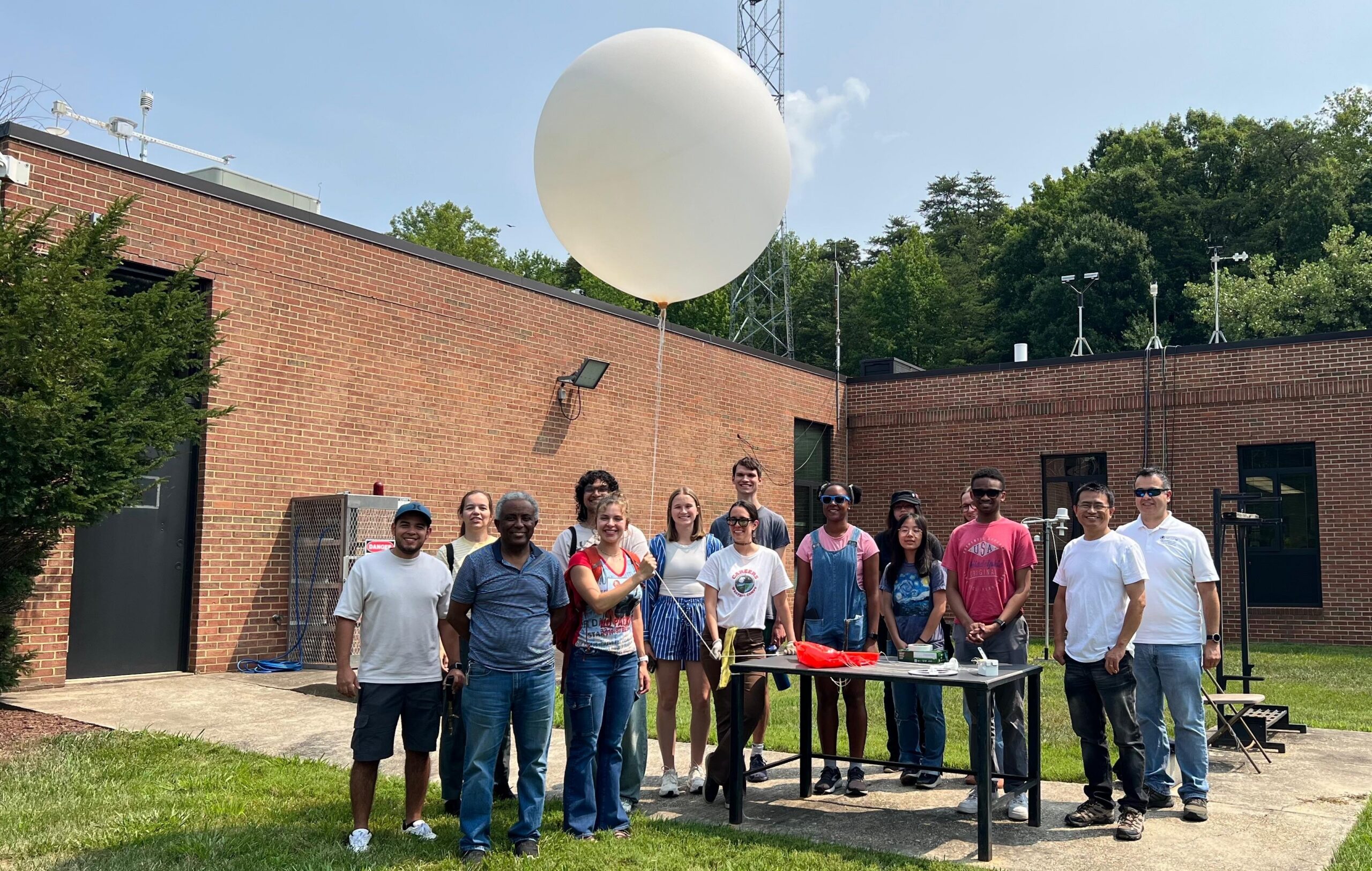
We could not finish our tour without the much-anticipated balloon launch!
Here students didn’t simply hear about the process; they participated.
They learned how radiosonde continuously measures atmospheric variables such as temperature, pressure, and relative humidity, while its position is tracked to determine wind speed and direction, and how that information is relayed back to our station via radio waves.

We had meaningful conversations as to the “why” we do the things we do. Radiosonde data provide the vertical atmospheric profiles that are essential for weather forecasting, atmospheric research, climate studies, and satellite validation. The cohort did not fall behind and asked very good questions that made for a long afternoon of conversation and lively scientific exchange.