
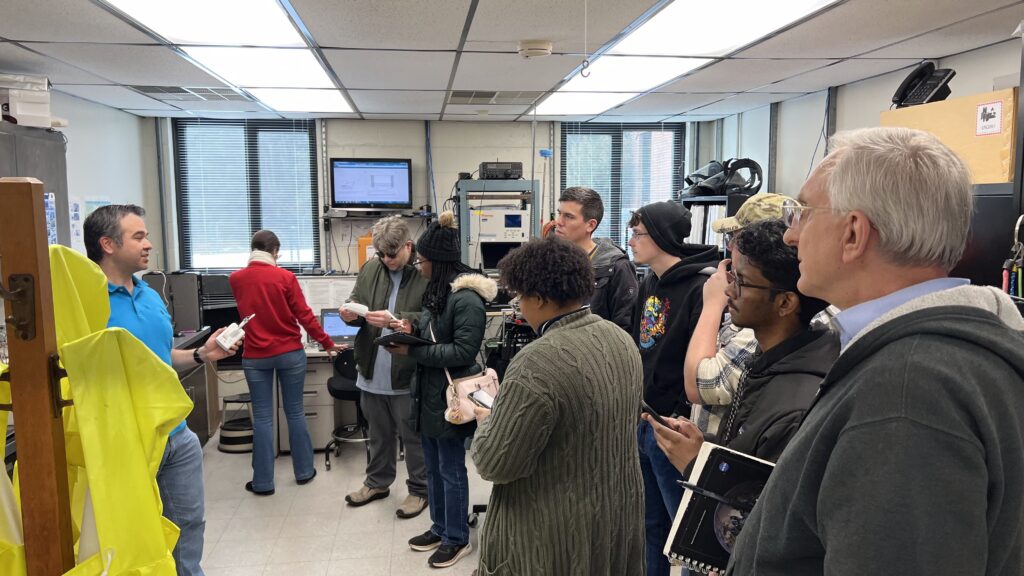
On February 11th, 2026, HUBC (Howard University Beltsville Campus) had the pleasure of hosting Jeffrey Volosin’s students from Capitol Technology University. Volosin, Director of the Astronautical and Space Engineering Undergraduate Program, brought an outstanding group of students eager to deepen their understanding of atmospheric science and instrumentation.
During their visit to the radiosonde laboratory, students explored the critical role of radiosondes, ozone sondes, and the CFH (Cryogenic Frostpoint Hygrometer) in obtaining atmospheric profiles. Dr. Ricardo Sakai, senior researcher, alongside researchers Adrian Flores, and Rocio Rossi, all delved into the physics and chemistry that must be carefully considered when planning each launch. From thermodynamics and radiative processes to trace gas chemistry and sensor response time, the students engaged thoughtfully and asked insightful questions.
This was truly one of the best student visitor groups we have had in a long time: motivated, prepared, and already thinking like engineers.

Student Assisting in the Launch of an RS-92
Following the laboratory session, students joined us in the field for a live RS-92 radiosonde launch. Seeing theory translate into real-world application gave them direct exposure to the operational side of atmospheric sounding: from pre-launch preparation and sensor checks to balloon handling and data collection.
Many of the students expressed interest in designing their own payloads and conducting launches of their own, applying what they learned about atmospheric profiling instruments and planning constraints. We look forward to welcoming them back to HUBC soon, where they will present their student-designed payload concepts and receive guidance as they move toward conducting their own launches.
It was a pleasure to share our facilities, experience, and passion for atmospheric research with such an engaged and forward-thinking group.