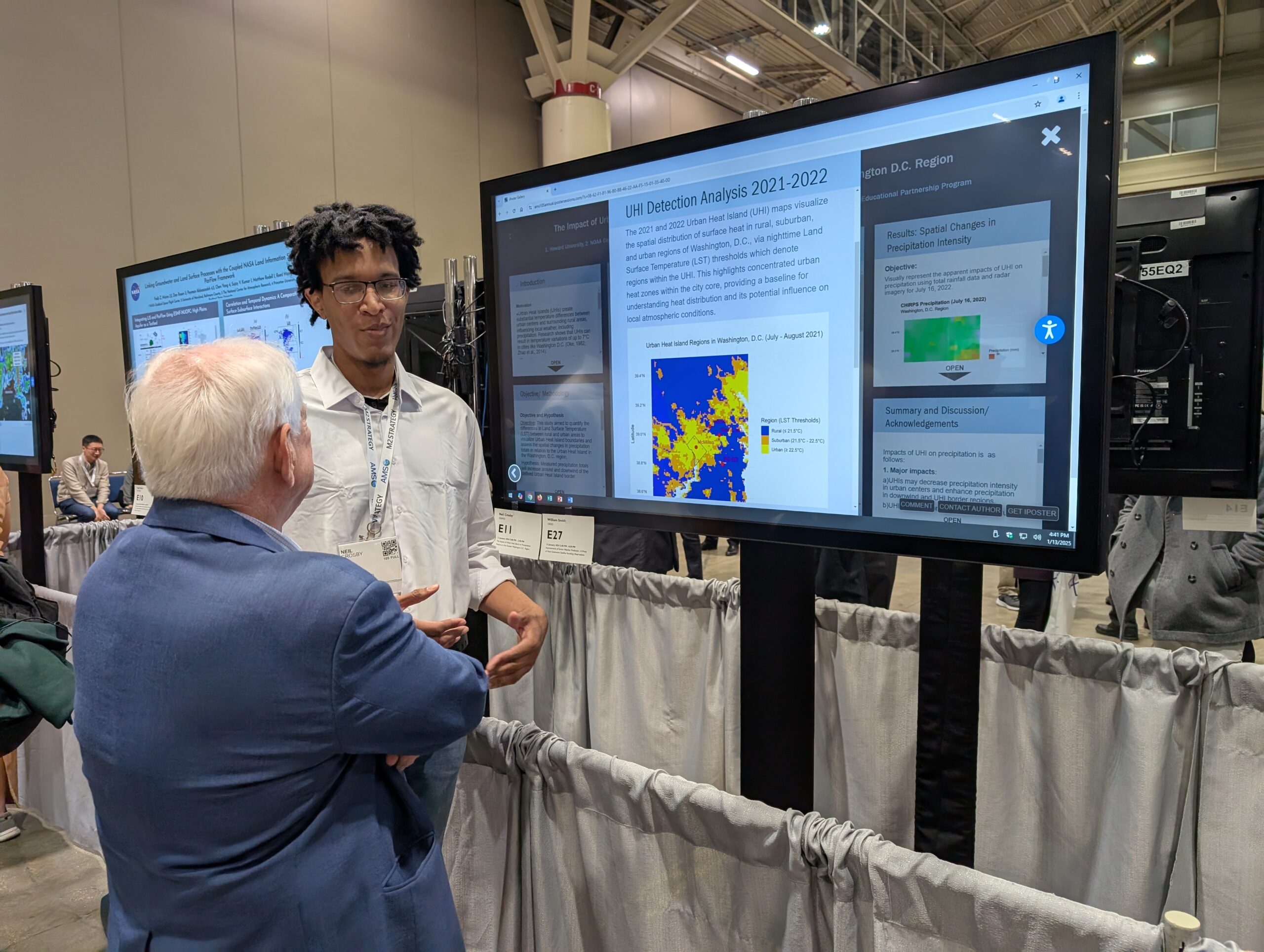
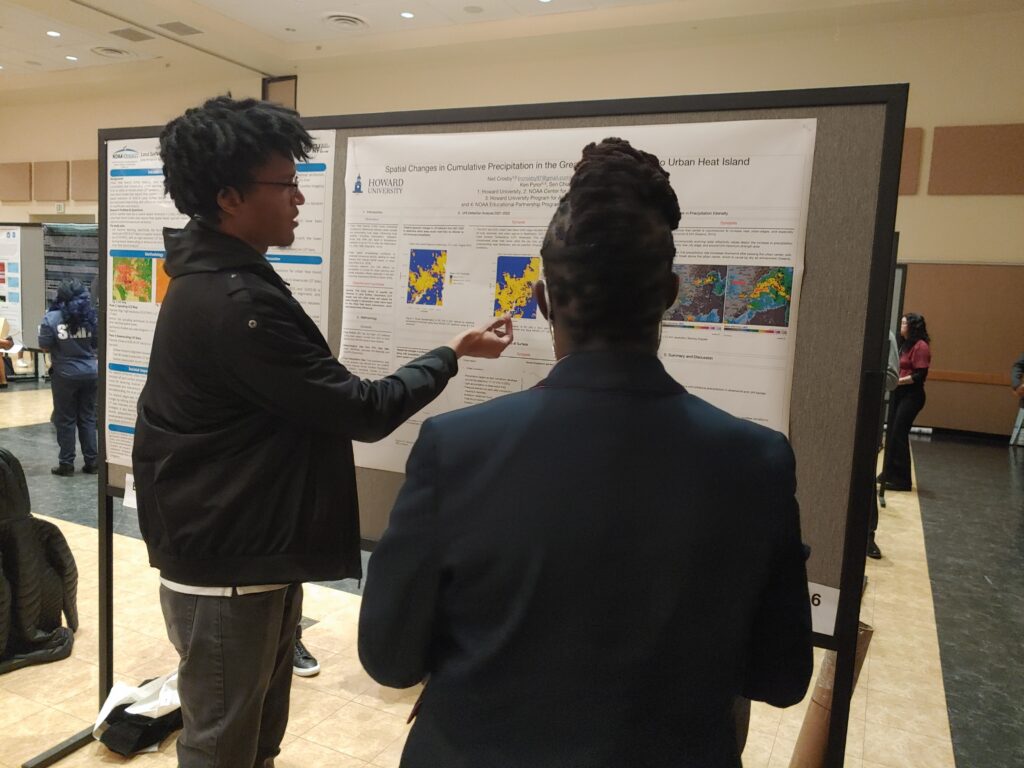
On April 24, 2026, Howard University Beltsville Campus (HUBC) student Neil Crosby will defend his Master’s thesis titled “Urban Heat Islands and Precipitation Redistribution in Washington DC: A Multi-Event Study.” Urban heat islands (UHIs) represent one of the most prominent urban–climate interactions, influencing both temperature and precipitation patterns. In Washington, D.C., strong nighttime thermal contrasts are frequently observed between the urban core and surrounding rural areas, raising the question of whether these differences systematically alter rainfall distribution. This study asks: Does the strength of the UHI consistently modulate precipitation, and are rainfall maxima displaced downwind of the city center during convective events?To address this, twelve significant precipitation events from July 2022 through July 2025 were examined, including both warm-season thunderstorms and cold-season storms. The analysis draws on Aqua MODIS nighttime land surface temperature (LST) data to visualize UHIs across the region, surface temperature records from the Maryland Department of the Environment (MDE) to quantify UHI strength (urban minus rural temperature), and precipitation estimates from the CHIRPS satellite dataset. HUBC served as the reference site for suburban conditions, enabling urban–suburban–rural comparisons across the case set. Results from CHIRPS estimates reveal a consistent pattern of enhanced precipitation within 20–40 km downwind of the D.C. urban center, with storm-track orientation via radar reflectivity closely aligning with observed rainfall maxima. UHI strength varied by event but generally peaked prior to or during storm onset, supporting its role in convective organization. Suburban areas often acted as transition zones, where enhanced rainfall coincided with storm motion through the urban–rural boundary. These findings suggest that Washington, D.C.’s UHI contributes measurably to precipitation redistribution, with implications for urban hydrology, flood risk management, and the integration of urban land surface effects into forecast models. HUBC wishes Neil good luck on his presentation and a follow up blog of his defense will be posted soon.
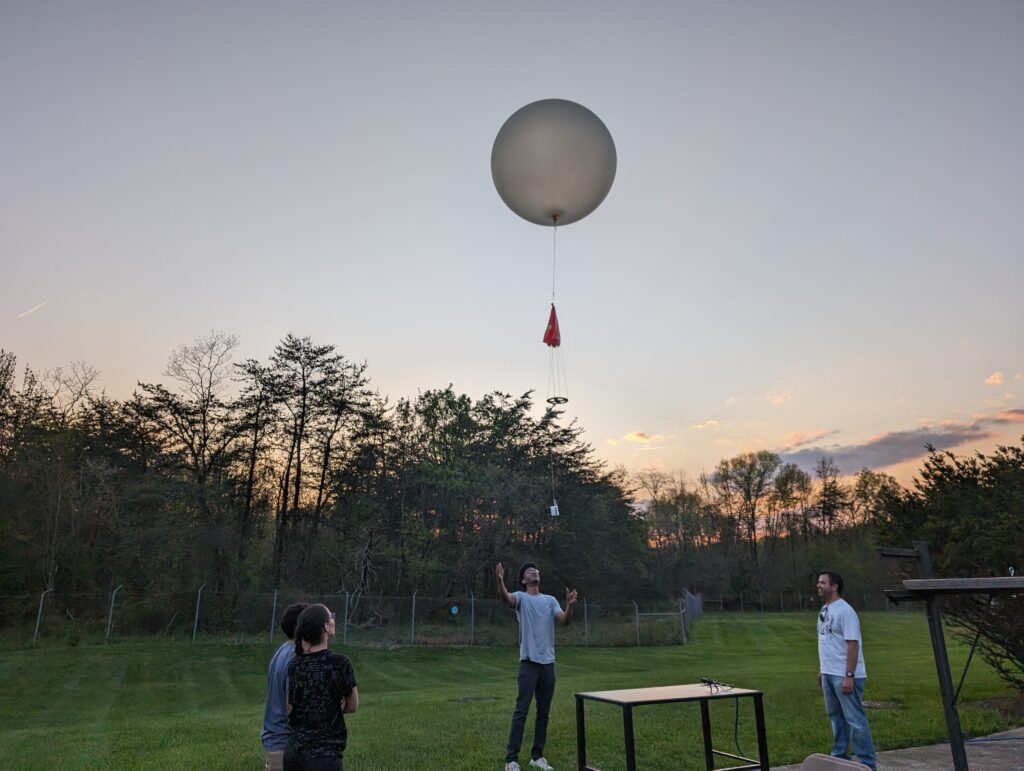
Neil launching a weather balloon with the supervising of Adrian Flores and Rocio Rossi